
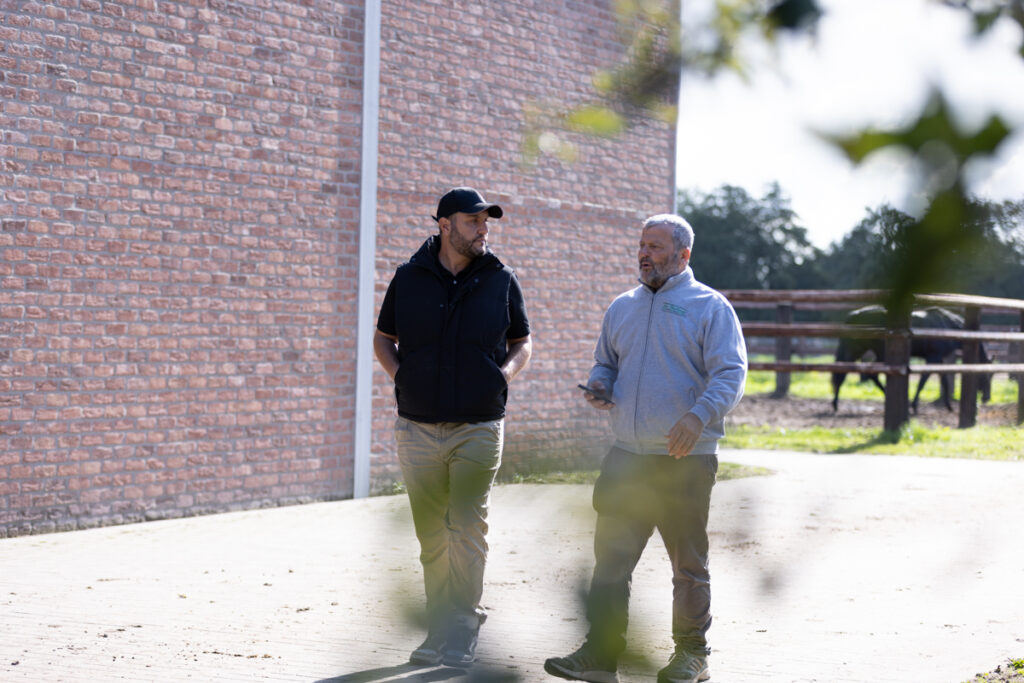
Some visits go far beyond simply discovering a breeding operation. We had the chance to spend a full morning at Stal de Muze in Belgium with Joris De Brabander and Christophe De Brabander, sharing several hours of discussion, observation and learning at the heart of one of the most influential breeding structures in international showjumping.
Stal de Muze, a reference in international breeding
The story of Stal de Muze began in the late 1980s around Joris De Brabander, a veterinarian by training. Over the years, the breeding program has become one of the most respected names in modern showjumping, producing and developing horses that have left a major mark on the sport. Stallions such as Nabab de Rêve, Vigo d’Arsouilles, Bamako de Muze and Kashmir van Schuttershof have had a lasting influence on breeding worldwide.
Joris De Brabander was also one of the early breeders to make extensive use of embryo transfer in sport horse breeding. Today, Stal de Muze combines breeding, reproduction, stallion management and sport within one complete system, where genetics are never separated from the real knowledge of the horses themselves. Christophe, also a veterinarian, is now closely involved in the reproduction, health and development of the younger generations within the operation.
Discovering the horses behind the pedigrees
We started the morning with a full tour of the facilities and, most importantly, with the opportunity to see the horses themselves. Being able to observe the stallions in person adds something that no pedigree, video or statistic can fully replace.
We were especially lucky to see Mosito van het Hellehof, as well as many of the other stallions based at Stal de Muze, and to discuss their qualities, production and the breeding decisions made around them. It was a strong reminder that behind every famous name in a pedigree there is first and foremost a horse, with its own conformation, temperament, strengths and limitations.
The visit then continued over coffee, with long and very open discussions about their breeding philosophy, the evolution of the sport and the future of the structure.
Breeding respectful horses, but not at the expense of courage
One of the ideas that stood out most was Joris’ reflection on the balance between respect and courage. For many years, breeding a horse that was extremely careful over the fence could seem like an absolute priority. With experience, his view has become more nuanced.
A top sport horse must of course be respectful and careful, but if that quality is pushed too far, it can sometimes come at the expense of courage. Modern sport requires horses that are attentive to the fences, but also willing to move forward, make decisions and keep fighting when courses become difficult.
This perfectly illustrates one of the main challenges of breeding: not selecting one quality in isolation, but finding the right overall balance.
Building a damline over generations
Another major point was the importance of working with strong maternal families and thinking several generations ahead. When a young mare gives the feeling that she is better than her mother, the best decision is not always to sell her. Sometimes, she should become the next step in the family.
Keeping selected daughters allows a breeder to improve a line generation after generation, preserving what works while trying to add what is still missing. This long-term approach is deeply rooted in the philosophy of Stal de Muze. Many of today’s results are the consequence of choices made ten, fifteen or even twenty years ago.
It is also a reminder that knowing the actual horses behind a pedigree is just as important as knowing the names written on paper.
Proven stallions, but also carefully selected young prospects
Our discussion about stallion selection was equally interesting. Whenever possible, the preference is clearly to use stallions that have already proven themselves at high level. A complete sport career gives valuable information about a horse’s ability, mindset, consistency, longevity and reaction to pressure.
At the same time, Stal de Muze also uses some younger stallions. The difference lies in the depth of selection. These horses are not chosen simply because they show talent in a free-jumping session or have an attractive pedigree. They are selected with a deep knowledge of their family, their dam, their granddam and the qualities that have genuinely been transmitted through several generations.
Movement as a key part of breeding
Another point Joris strongly emphasized was the importance of movement for broodmares and young horses. In his view, mares and foals need to be outside and walking as much as possible.
Movement plays an essential role in the development of the young horse, its soundness and its overall balance. For Joris, a horse’s future career starts long before its first competition. It begins during gestation, through the living conditions of the broodmare, and continues throughout the foal’s growth.
This very simple principle is also one of the strongest: good genetics need the right environment to fully express themselves.
The memories that shaped a breeding career
Of course, after several hours of talking about breeding, we also spoke about memories. Certain horses, certain choices that later proved to be decisive, and horses that gave no obvious indication at three or four years old that they would one day become international stars.
That is also what makes breeding so fascinating. Even with decades of experience, thousands of horses observed and access to some of the best bloodlines in the world, there is always a part of uncertainty. And perhaps that is exactly what keeps great breeders searching, questioning and evolving.
A morning we will not forget
We came to discover Stal de Muze, but we left with much more than that. Open discussions, decades of experience shared with generosity, some convictions reinforced and others challenged. Talking with people who have helped shape some of the most important bloodlines in modern showjumping is a powerful reminder that breeding is never an exact science. Pedigrees, performance and knowledge matter enormously, but so do observation, instinct, patience and the ability to keep changing your mind.
A huge thank you to Joris and Christophe De Brabander for their welcome, their time and the openness with which they shared their vision. And of course, we did not leave empty-handed: a cap, a jacket, a few Stal de Muze gifts and, naturally, the famous Gazette de Muze. But the most valuable thing we brought home was undoubtedly everything we learned during those few hours.